

Painting, printing, wearing: Judumul's creative economy
Spotlight on
28 August 2026
Coolgardie is an old goldfields town in WA with a huge community spirit. Surrounded by vast desert Country, the tight-knit community is big on caring for one another, celebrating culture and looking after the land.
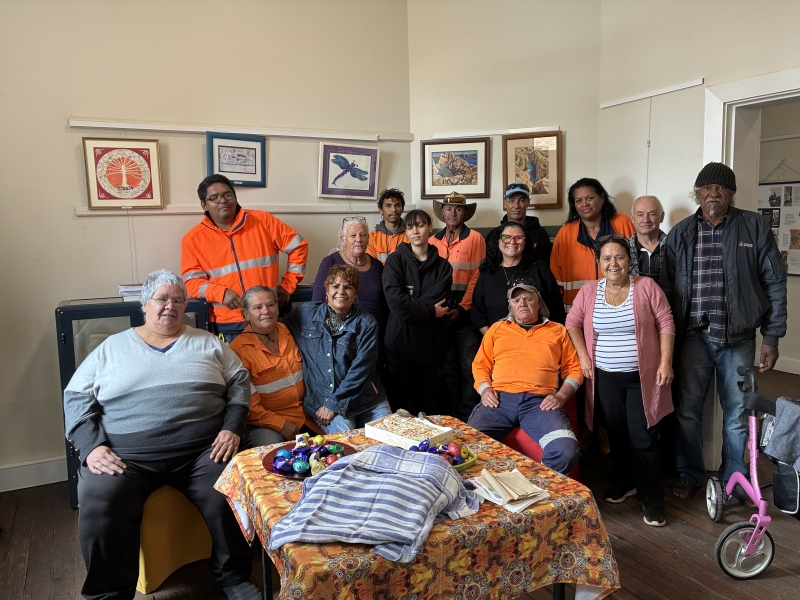
Judumul Aboriginal Corporation facilitates this as a community-owned and controlled organisation. It was set up as a way for Aboriginal residents of Coolgardie to achieve their goals, and provides services to the whole community.
Judumul began as a meeting place, expanded through a cemetery working bee, started up a gallery, and has become a genuine hub for the town's Aboriginal community.
It now employs 17 people, runs programs from yard maintenance to driver training, and has just held its most ambitious exhibition yet, Women Still Dreaming. Its governance model is built on open communication, and a conviction that community members should have the final say in how the organisation runs.
From a pub lounge to a gallery of their own
CEO Rhonda Evans came to Judumul after a 20-year career in local government, including years working with the Shire of Coolgardie. She used to visit twice a year, watching the same grant applications stall.
'This community had the vision and the drive – what it needed was a hand turning that into funded programs,' says Rhonda. 'So eventually I told them: I'll keep coming, but let's actually go after what you need.'
That conversation set the direction. Rhonda brought knowledge of government processes to help with grant writing, and gave Judumul the boost it needed to get off the ground.
It wasn't a fast start. The new organisation had nowhere to call home at first. Rhonda and chairperson, Rose Mitchell (who is also artist in residence), met weekly in the lounge of a local pub. A break came when the Shire leased Judumul the old bowling club.
'That's when we opened our first art gallery,' Rhonda says. It launched during NAIDOC Week in 2022, showcasing Rose’s artwork and other local artists, and became the corporation's first real program.
That same year, Judumul secured a small grant from the National Indigenous Australians Agency (NIAA) to mark unnamed Aboriginal graves in the local cemetery, some dating back to 1893.
'We planted name markers on them,' Rose recalls. 'That was our first project.'
Employment on the community's terms
That same community-led approach shapes how Judumul treats its own staff. Its 17 employees are offered flexible hours rather than a standard 9-to-5.
'Mining is the big local industry, but it means 12-hour days and strict rules on lifestyle and having a licence,' Rhonda says. 'That excludes a lot of people. We try to offer culturally appropriate hours, and we recognise that people will have times when they've got sorry business or family responsibilities, and we work around that.'
That flexibility extends to how staff manage their own policies. When workers wanted a policy for extended time away, they wrote it themselves: four weeks without contact, and the job is understood to be given up.
'They made that decision, and they accept it,' Rhonda says. 'It was their call, not ours.'
Programs that grow from what the community needs
Community decisions have guided the way Judumul was set up, and guide which services it provides.
A yard maintenance crew, an edible garden at the local Retiree's Cottage and upkeep of the cemetery plots build pride in a tidy town. A driver training program has helped 34 of more than 40 participants get their licence.
'That's a very high strike rate,' Rhonda says. 'A licence opens up so much more than driving – it's what stands between people and a lot of local jobs, so every person who gets one has a real shot at going after the work they want.'
But one of Judumul’s proudest moments came when it held an exhibition of hand-printed garments, featuring local artists’ designs and made in-house on their machines.
With grant funding from GEDC and BHP, and support from the Shire of Coolgardie, Judumul set up a printing studio in 2023. This led to Judumul's first Women Still Dreaming exhibition in November 2023. It paired 68 pieces from 5 local artists (growing to 9 in 2025) – including Rose – with a fashion parade of bespoke and upcycled garments. Many were built from Rose's fabric prints and pieces sourced from the gallery's Clothes-4-You op shop.
A team of local women did the sewing, reporting a feeling of wellbeing and self-rediscovery tied to their pieces along the way.
Building beyond Coolgardie
Judumul's reach now extends past its own programs. It provides fee-for-service payroll and administration support to other local organisations, including Mingarwee Aboriginal Corporation, which manages 9 houses in town.
It also partnered with Millennium Kids’ Kids on Country program on WAKE UP THE SNAKE, a project on the intergenerational transfer of knowledge built from 15 years of on-country visits, which was on show at WA Museum Boola Bardip earlier this year, before closing in June. Judumul has secured 30 metres of gallery space to bring the exhibition home to Coolgardie.
Underlying all of it is the trust Rose says takes time to earn.
'Aboriginal people need to develop trust in the people they're working with before they'll come on board,' she says. 'That's part of why a lot of companies struggle to keep our people. Mining companies have been good to us, but for the most part they're very corporate-focused, and that doesn't always work with our communities.’
For Judumul, growth has come from listening: to Rose's vision for a gallery, to staff working out their own policies, to a community deciding what its own programs should look like. And it’s succeeding in its goals to support residents who look out for one another, celebrate culture, and care for the Country it calls home.